Ottawa Construction News staff writer
U.S. President Donald Trump has paused plans to impose a 50% tariff on hundreds of Canadian goods including cement, drywall, hardwood products and other construction materials, less than two hours before the new duties were set to take effect.
Trump said late Tuesday that he was delaying the tariffs for three days as Canada and the United States work toward a potential agreement.
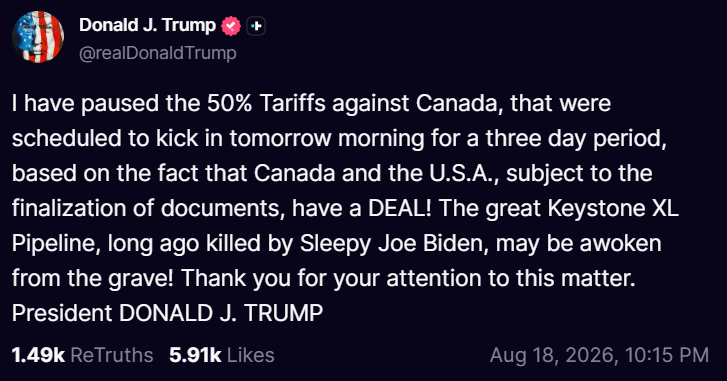
“I have paused the 50% Tariffs against Canada, that were scheduled to kick in tomorrow morning for a three day period, based on the fact that Canada and the U.S.A., subject to the finalization of documents, have a DEAL!” Trump wrote on Truth Social.
Prime Minister Mark Carney stopped short of announcing a deal in his statement late Tuesday.
“Substantial progress has been made, although there is important work still to be done,” Carney wrote. “As this work is ongoing, the United States has agreed to postpone the implementation of its 50% tariff on a range of Canadian goods under Section 338 of the U.S. Tariff Act of 1930 until end of day, August 21.
“While we continue this work, Canada remains focused on building a stronger, more independent and more competitive economy at home.”
Trump also referred to the Keystone XL pipeline, saying it “may be awoken from the grave,” but did not provide details about what role the pipeline could play in a potential agreement.
The pause comes after several days of negotiations between the two countries. Carney and Trump spoke Monday and Tuesday as officials worked to resolve the trade dispute.
Carney described the negotiations as “very delicate and intense.”
In a statement Tuesday night, Carney confirmed the tariffs had been postponed until the end of the day Aug. 21.
“Substantial progress has been made, although there is important work still to be done,” Carney said.
Trump has accused Canada of making it more difficult for U.S. companies to export dairy products, cars and alcohol to the Canadian market. Canada was also the only country besides China to retaliate against Trump’s earlier tariffs, although Carney’s government later removed most of those measures.
The proposed tariffs would have affected hundreds of Canadian products and could have had a significant impact on industries on both sides of the border, particularly construction materials and other goods incorporated into U.S. supply chains.
Unlike some of the other tariffs imposed by Trump under different authorities, the duties proposed under Section 338 of the Tariff Act of 1930 do not appear to have a specific expiration date. If imposed, they could remain in place indefinitely unless Trump or a future president removed them.
Carney has previously called the tariffs a “direct violation” of the Canada-U.S.-Mexico trade agreement.
The U.S. Chamber of Commerce warned Tuesday that higher tariffs would hurt both countries by increasing costs for consumers, disrupting supply chains and putting jobs at risk.
The chamber said about 13 million U.S. jobs depend on trade under the United States-Mexico-Canada Agreement.
The three-day pause gives Canadian and U.S. negotiators until Aug. 21 to finalize an agreement and determine whether the threatened tariffs will be withdrawn, modified or imposed.