Ottawa Construction News staff writer
Capital Crossing Constructors has selected Aecom as the lead designer for the Alexandra Bridge replacement in Ottawa, a major infrastructure project that will connect Ottawa, Ontario and Gatineau, Quebec.
Replacing the existing Alexandra Bridge, the new structure will be designed to support long-term mobility, connectivity, and accessibility for all users in the National Capital Region.
“Our selection for this landmark project reflects the strength of AECOM’s multidisciplinary capabilities and our collaborative approach to delivering complex infrastructure solutions,” said Richard Barrett, chief executive of AECOM’s Canada region. “As a Canadian team, we are proud to contribute to a transformative project in the nation’s capital that will support regional connectivity and create long-lasting value for communities on both sides of the Ottawa River.”
AECOM will provide environmental services, bridge architecture, structural and civil engineering, traffic management design, utility coordination, and public consultation support. The project will be delivered using building information modeling (BIM) and fully digital project delivery tools.
In partnership with Capital Crossing Constructors, a joint venture comprising Webuild Civil Works Inc., Samsung C&T Ontario 1 Inc., and Green Infrastructure Partners Inc., AECOM’s integrated team will help advance the planning and design of this critical infrastructure replacement.
Working closely with the Government of Canada, the team will develop a technical solution aligned with the Government’s objectives for sustainability, resilience, constructability, and effective stakeholder engagement.
The new structure will replace the existing Alexandra Bridge, which is more than 120 years old and has reached the end of its service life. Construction of the replacement is expected to begin in 2028.
The crossing is intended to improve long-term mobility, connectivity and accessibility for motorists, pedestrians and cyclists travelling between Ottawa and Gatineau.
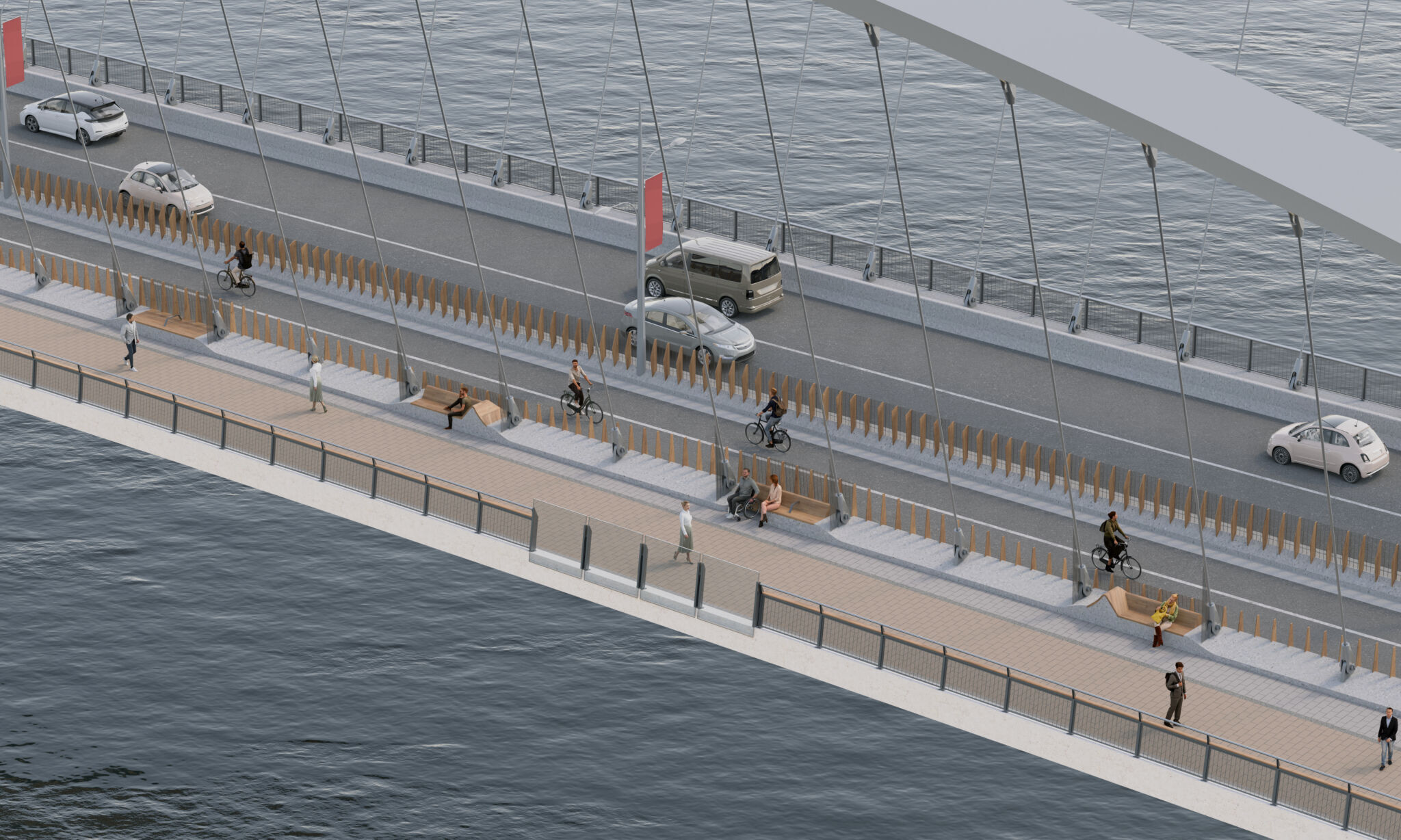
Inspired by nature and the movement of the river, the bridge’s form is defined by three undulating arches. These arches reference the river’s moving water, the contours of the shoreline and escarpment, and the curved facade of the Canadian Museum of History.
These renderings are for presentational/reference purposes. The design builder will further adapt the preferred concept.
Furnishings and seasonal comfort
The bridge features several comfortable seating areas along its length that are designed for pedestrians and wheelchair users. There are also sheltered nooks located under the arches, and shading structures could be provided at seating locations along the bridge. Within the arches, two rows of timber panels provide protection from the wind, with additional wind protection provided at seating locations to improve comfort.