Ottawa Construction News staff writer
The National Capital Commission (NCC) has formally approved the schematic design for the Alexandra Bridge replacement, locking in the vision for the capital’s next major infrastructure landmark and clearing the way for detailed engineering to begin.
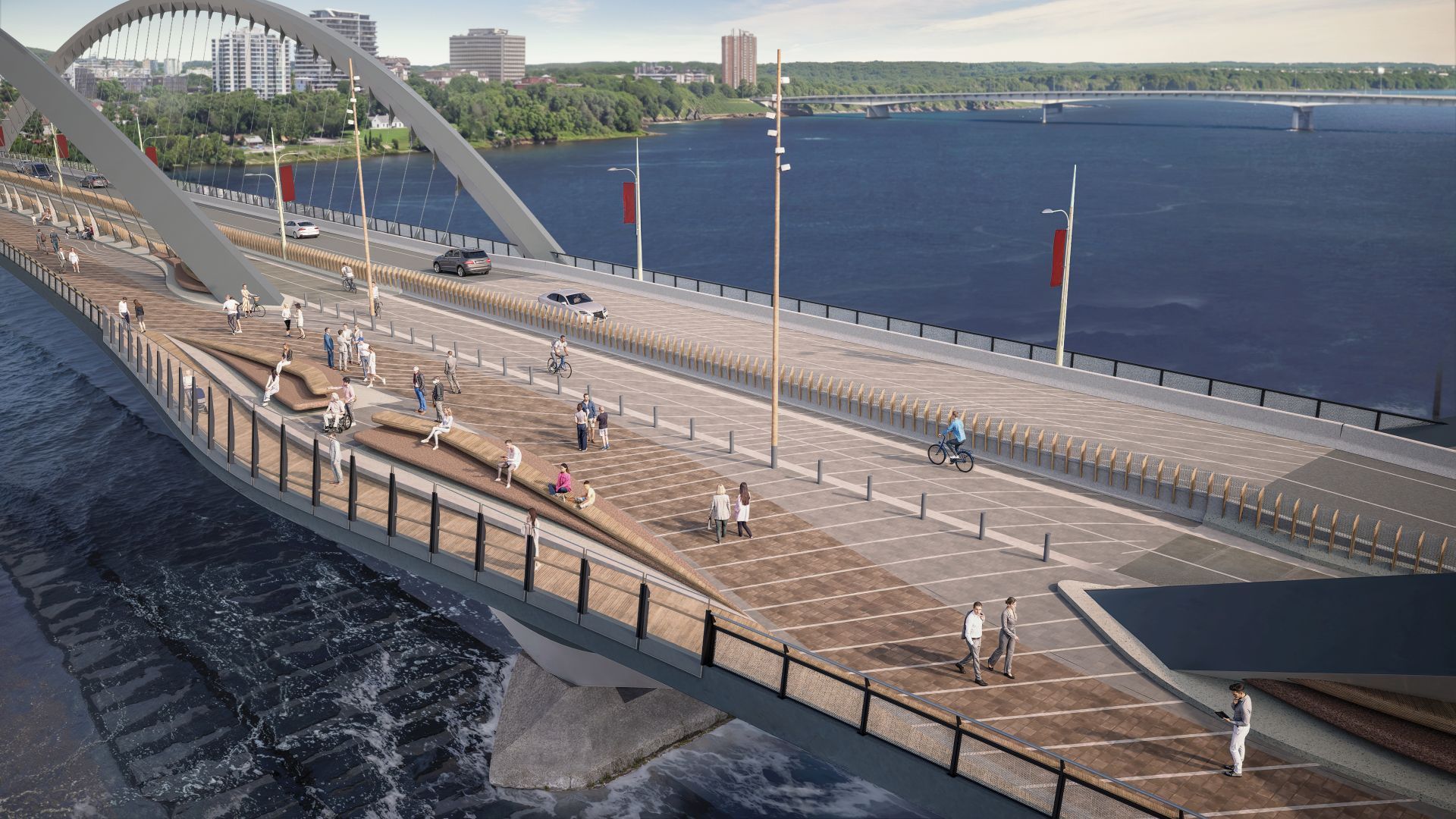
At its board meeting on Jan. 22, the NCC granted federal land use and design approval to the “Motion” concept—a structure featuring three undulating arches inspired by the Ottawa River’s currents and the American eel.
The approval is a pivotal milestone for the massive project, transitioning it from conceptual debate to the hard reality of procurement and construction. With the design vision fixed, the focus now shifts to selecting the builders who will dismantle the 125-year-old steel truss bridge and erect its modern successor.
“The schematic design establishes the overall vision for the project before moving into more detailed design development and construction,” the NCC said in a statement following the approval. “This federal land use and design approval will allow the integrated project team and the future design-build partner to continue preparatory work needed to advance toward construction.”
A defining new silhouette
The approved “Motion” design features a signature central arch flanked by two smaller secondary arches, creating a rhythmic profile that aims to complement, rather than compete with, the views of Parliament Hill and the Canadian Museum of History.
Key features of the approved schematic include:
- Wider deck: Expanded capacity for active transportation, with a central lane for potential future transit and generous separated paths for pedestrians and cyclists.
- Public spaces: “Lookout” areas integrated into the bridge deck, designed to serve as destinations for viewing the capital skyline.
- Heritage nods: While the old bridge will be removed, the new design incorporates interpretive elements to honour the legacy of the original 1901 railway crossing.
The decision follows the NCC’s selection of “Motion” as the preferred concept in early 2025, beating out a competing “Echo” design.
The race to build
With the design set, the construction industry is now vying for the contract to deliver the project. Public Services and Procurement Canada (PSPC) is currently managing a Request for Proposals (RFP) process with three pre-qualified consortia.
The shortlist of proponents, updated as of October 2025, features major international and domestic heavy hitters:
- Alexandra Legacy Partners: A team including Acciona Infrastructure Canada Inc., Aecon Infrastructure Management Inc., Parsons Inc., Pomerleau Major Projects Inc., and T.Y. Lin International Canada Inc.
- Capital Crossing Constructors: Comprising AECOM Canada ULC, Samsung C&T Corporation, and Webuild S.p.A.
- Epoch Pathway Ontario-Québec Partners: Featuring Flatiron Dragados Canada Inc., EBC Inc., Construction Demathieu & Bard Inc., Hatch Ltd., and Carlos Fernandez Casado S.L.
The federal government is using a progressive design-build model for the project, a collaborative approach intended to reduce risks and accelerate timelines by bringing the construction partner on board early in the design phase.
Timeline and controversy
Despite the forward momentum, the project remains contentious. Heritage advocacy groups, including the Alexandra Bridge Coalition, have campaigned vigorously to save the existing structure, arguing it could be rehabilitated.
However, the NCC and PSPC have held firm on the replacement strategy, citing irreversible structural deterioration and the need for a safer, more functional crossing.
The current schedule outlines a busy few years ahead:
- Spring 2026: Expected selection of the design-build partner.
- 2026-2028: Detailed design development and site preparation.
- 2028: Construction begins, starting with the demolition of the existing bridge.
- 2032: Targeted opening of the new Alexandra Bridge.
The NCC says it will continue to consult with Indigenous communities and the public as the project moves into its granular design phases, focusing on how the new bridge will integrate with the shorelines and public spaces on both the Ottawa and Gatineau sides.
The project is led by PSPC in collaboration with the NCC, which holds authority over federal land use and design in the capital region.