Ottawa Construction News staff writer
OTTAWA — The National Capital Commission (NCC) has launched a dual-stream procurement process to shape the Aqueduct District, unlocking a massive pipeline of bidding opportunities that will define the cultural and entertainment heart of LeBreton Flats.
Issued last Friday (Oct. 30), the Request for Expressions of Interest (EOI) utilizes a coordinated, two-document process targeting distinct sectors of the development and business communities.
The first stream is designed for destination and tourism operators, such as hospitality, retail, and entertainment businesses, alongside non-developer community partners. The second stream targets private execution development partners, including developers, investors, and integrated delivery teams. The chosen development partner will lead the integrated delivery of the district under a long-term ground lease with the NCC.
“The redevelopment of LeBreton Flats is a once-in-a-generation opportunity,” the NCC stated in the foreword of the EOI documents. “The Aqueduct District represents a chance to create an iconic place that celebrates heritage, embraces innovation and becomes a destination for residents and visitors alike for decades to come.”
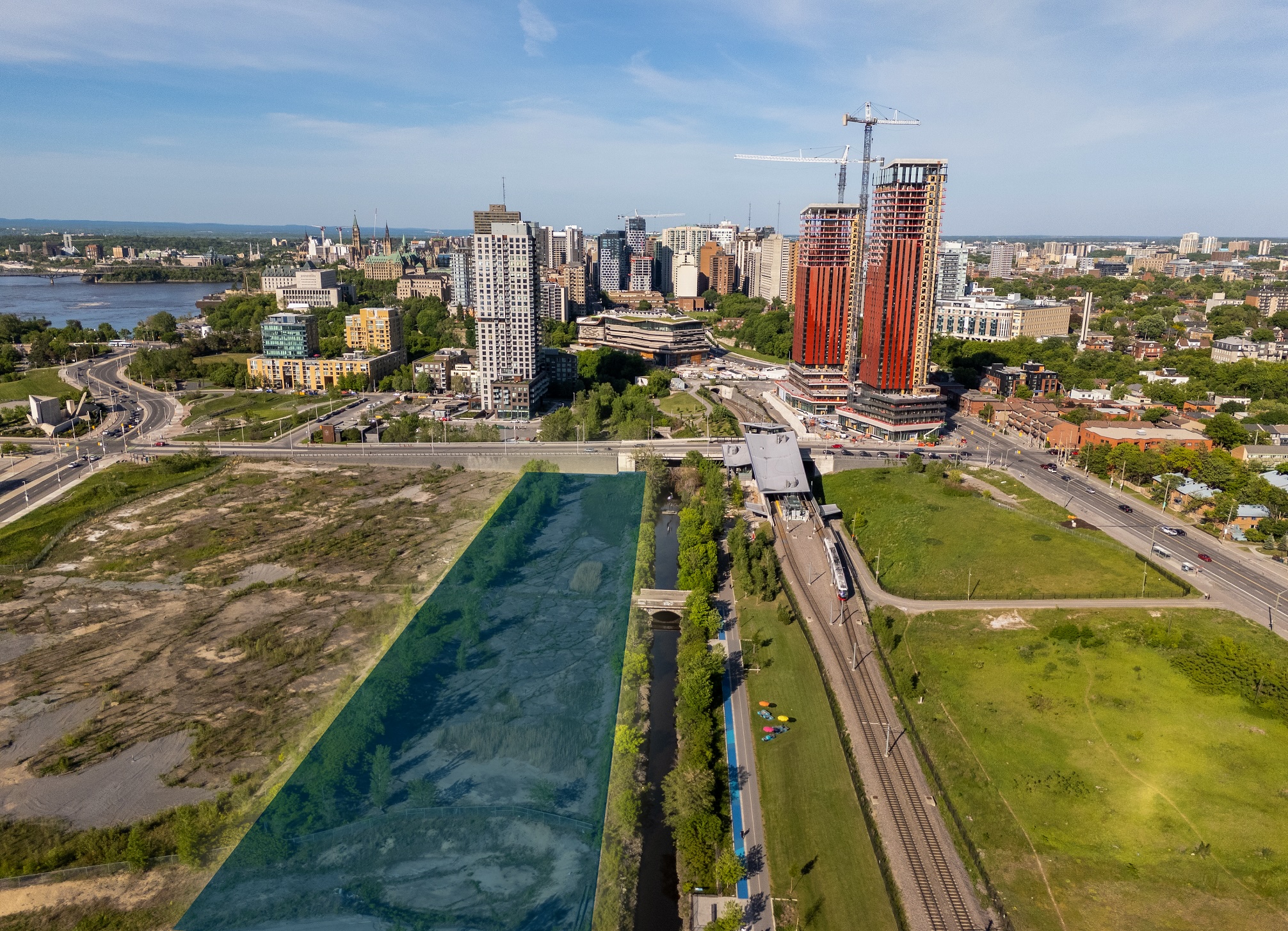
The specific development site is identified as Block 17, a 4,755.6-sq. m. parcel featuring prominent southern frontage along the heritage Ottawa aqueduct, originally constructed in 1872. The site sits immediately adjacent to the planned Major Events Centre — the future home of the National Hockey League’s Ottawa Senators — which is anticipated to commence operations in the mid-2030s.
The Aqueduct District serves as the centrepiece of the broader 29-hectare LeBreton Flats Master Concept Plan, a decades-long urban renewal project west of Ottawa’s downtown core. The full 35-year build-out is expected to deliver more than 500,000 sq. m. of total floor area, including 65,000 sq. m. of office and commercial space, 12.5 hectares of parks, and 4,000 residential units.
Given the massive capital requirements and complex integration of public and private spaces, the NCC is structuring the EOI to accommodate joint ventures and multi-party consortiums.
For developers preparing Stream 2 submissions, the NCC’s evaluation criteria place a heavy 20-point emphasis on team composition, requiring the clear identification of joint venture partners, investors, and their prior collaboration on comparable complex projects.
Furthermore, bidders must demonstrate robust financial capacity and investment strength, which accounts for 25 points in the evaluation. Submissions must detail the proposed financial structure for executing the project, including how the development team plans to fund the required public realm and on-site infrastructure, potentially utilizing “creative rent structures” to enable delivery.
Bidders are required to provide a statement characterizing their access to equity sources, institutional partners, and debt-financing relationships, backed by a reference letter from a Schedule I Canadian bank or recognized financial institution confirming their creditworthiness.
Winning bidders will also be required to navigate strict socio-economic mandates. A central pillar for general contractors and developers submitting proposals is the mandatory Algonquin Nation Benefits Plan.
To align with the NCC’s partnership commitments, developers must target five per cent of the total project budget strictly for workforce, training, and contracting set-asides designated for Algonquin Nation workers and enterprises. Prime contractors will need to structure their sub-trade procurement to ensure five per cent of the contract value flows to qualified Indigenous businesses.
Additionally, the benefits plan requires contractors to dedicate five per cent of on-site employment hours to Algonquin and Indigenous workers, establish formal apprenticeship opportunities during the construction phase, and provide Indigenous awareness training for all project staff. Developers must also prioritize a portion of any low-cost or affordable housing units for Algonquin Nation members through their business plans.
Across the entire LeBreton Flats site, the NCC requires that 25 per cent of all housing built be designated as affordable.
On the environmental front, all construction must adhere to a zero-carbon building standard. To achieve this, builders will bypass building-scale heating and cooling plants, instead tying their developments into a newly established district energy network.
The LeBreton Community Utility Partnership — a joint venture between Hydro Ottawa subsidiary Envari Holding Inc. and Theia Partners — is deploying an advanced Sewage Energy Exchange System (SEES) for the site. Operating entirely without fossil fuels, the four-pipe network will deliver low-carbon heating and cooling via electrified heat pumps.
The district is also expected to be serviced by the future extension of Vimy Place, a local street that will bring municipal water, sanitary, electrical, and gas services to the boundary, and will be constructed on behalf of the NCC by the developer of the adjacent Flats Phase.
Infrastructure and civil contractors will also see substantial opportunities in the site’s unique transit-oriented design. Internal roadways will feature “woonerf-style” shared-street configurations, which require specialized hardscaping to prioritize pedestrian and cyclist safety over automobile traffic.
Following the EOI evaluation, the NCC intends to either issue a Request for Proposals (RFP) to a shortlist of qualified respondents in early 2027 or enter directly into a 10-to-12-month exclusive negotiation period with a preferred partner. The indicative timeline projects planning, design, and approvals taking place between 2028 and 2030, with construction and occupancy slated for 2030 through 2033.
Prospective bidders have until Dec. 3, 2026, to submit inquiries to the NCC. Submissions for both streams are due by 4 p.m. EST on Dec. 16, 2026, and must be submitted electronically through the NCC’s Aqueduct District webpage portal. The NCC is also offering non-mandatory site visits upon request for proponents who complete a required confidentiality statement.