Ottawa Construction News
Federal Industry Minister Melanie Joly has given Stelco 15 days to reverse layoffs affecting up to 500 workers at its Hamilton steel plant or face potential legal action that could force the sale of its Canadian operations.
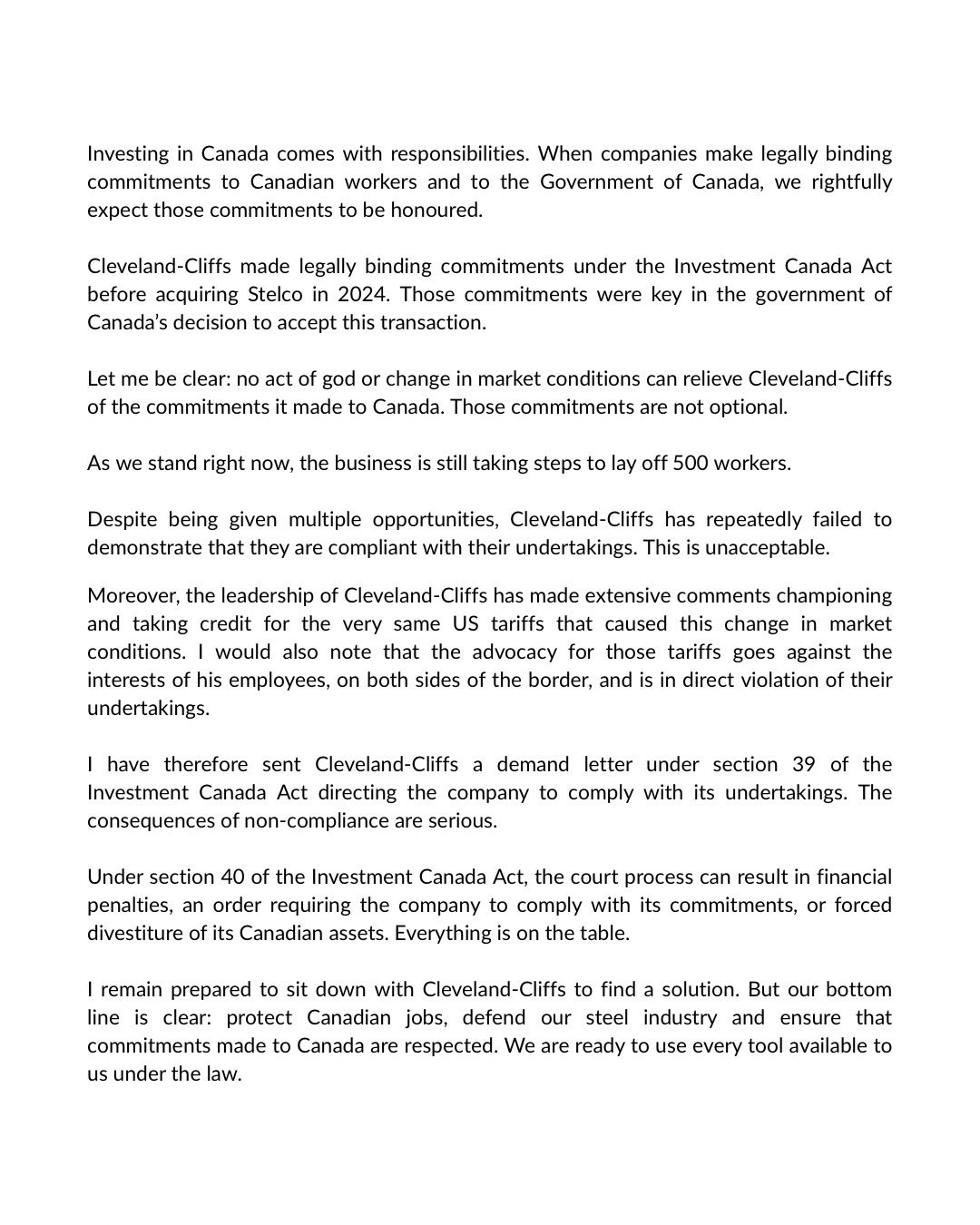
“Despite being given multiple opportunities, Cleveland-Cliffs has repeatedly failed to demonstrate that they are compliant with their undertakings,” Joly said in a statement. “Those commitments are not optional.”
The dispute centres on a 2024 agreement between the federal government and Cleveland-Cliffs, the U.S. company that owns Stelco, requiring minimum employment levels at its Canadian operations through 2029.
An agreement requires the company to maintain an average of at least 1,766 unionized employees in Canada, based on employment levels during the 12 months ending June 30, 2024. It also requires Cleveland-Cliffs to maintain at least 90 per cent of the baseline employment level for 603 non-unionized employees.
“Cleveland-Cliffs made legally binding commitments . . . before acquiring Stelco in 2024,” she said. “Those commitments were key in the government of Canada’s decision to accept this transaction.”
Joly says planned layoffs violate the agreement, but Cleveland-Cliffs disputes her claim and says the commitments do not prohibit layoffs or require the company to maintain specified employment levels on a daily basis throughout the agreement.
The company has said affected Hamilton workers would be offered positions at its Lake Erie facility.
Joly has warned that the federal government could pursue court action if Cleveland-Cliffs does not comply. Legal proceedings could ultimately lead to a forced sale of the company’s Canadian operations.
Cleveland-Cliffs has cited financial pressures at the Hamilton plant, including U.S. tariffs on Canadian steel, as contributing factors. The United States imposed tariffs on Canadian steel in February 2025, and the Trump administration subsequently raised them to 50 per cent.
The company has argued that it should not be held responsible for the effects of external factors beyond its control.